
This is opinion and commentary based on Ashley Geelan’s own public Bluesky posts. It treats his brothel story as his claim, not as an independently proven event.
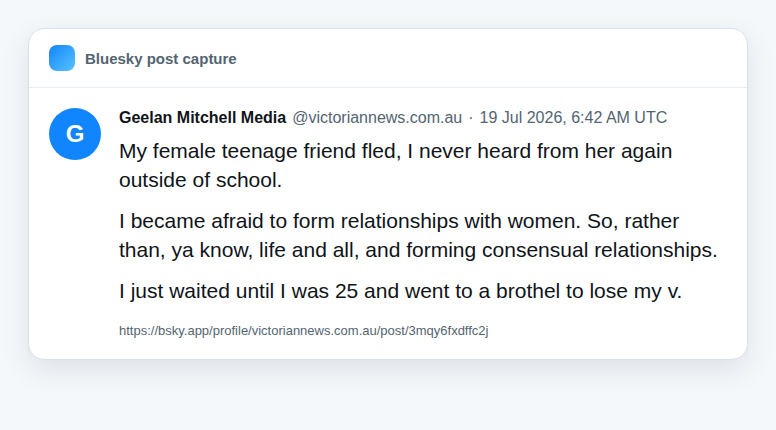
Ashley Geelan has now decided that his media-branded Bluesky account is the right place to tell the public that he went to a brothel at 25.
That is his choice. He published the story. He put it in a thread about radio, sexual assault, Neil Mitchell, Kyle Sandilands and his own childhood. He used it as part of another self-centred performance where every subject somehow turns back into Ashley Geelan.
But if Geelan wants to use that story as public moral authority, then it is fair to ask the questions he left unanswered.
Was it legal in Victoria in 2003?
Geelan says he was 25 when he went to a brothel. On the public dates we have used for his age, that points roughly to 2003.
Victoria was not operating under today’s decriminalised sex-work model in 2003. The current Victorian Government material says the Sex Work Decriminalisation Act 2022 repealed the Sex Work Act 1994, abolished the licensing system, and rolled those reforms out in May 2022 and December 2023. Before that reform, Victoria had a licensing and regulation model that came out of the old Prostitution Control Act 1994 / Sex Work Act 1994 framework.
So the legal question is not as simple as “brothel equals illegal”. A licensed brothel involving consenting adults was a different thing from an illegal brothel, coercion, underage exploitation, street solicitation, or a worker whose legal status was not what the client assumed. Geelan’s Bluesky story gives readers none of the details needed to know which situation he is asking them to picture.
Did he know whether the brothel was licensed? Did he know whether the woman was legally working? Did he know her age? Did he care enough to ask? His own post says he cannot remember her name and cannot remember what she looked like. That may be a dramatic confession, but it is not a reassuring one.
The contradiction he created
In the same autobiographical run, Geelan tells readers that a consensual teenage kiss led to his mother beating him, and that this supposedly made him afraid to form relationships with women. Then he says he waited until he was 25 and went to a brothel.
That is a strange moral arc to publish from a media account. If his mother was supposedly outraged by a consensual teenage kiss, what would she have thought of him turning an unknown woman in a brothel into a throwaway anecdote decades later?
This is not an attack on sex workers. Sex workers deserve safety, dignity, labour rights and freedom from stigma. The question is about Geelan, because Geelan is the one who turned an unnamed woman into supporting material for his own online drama.
He does not describe her as a person. He describes her as a blur: a random woman, no remembered name, no remembered face, no remembered body. That is not introspection. That is a man using someone else’s anonymity to make himself the centre of the story again.
Dole money and ethics
There is also the money question. If Geelan was on government benefits at the time, was spending that money on a brothel a good use of dole money? Was it ethical? If he was not on benefits then, he can say so. But the question matters because Geelan regularly presents himself as the injured moral accountant of everyone else’s life.
He wants to interrogate other people. Fine. Then his own public story can be interrogated too.
Is the story even true?
There is another possibility: perhaps the story is not true, or not true in the way he tells it.
Geelan has a long public habit of writing himself into the centre of bigger stories. He becomes the future journalist, the radio insider, the cadet-days veteran, the victim, the moral witness, the man who can “smell” wrongdoing from other people’s words. Yet when it comes to ordinary accountability, evidence, correction and responsibility, the performance often collapses.
So readers are entitled to ask: did this brothel story happen as told, or is it another Geelan set-piece designed to make him sound wounded, worldly and morally perceptive all at once?
And if it did happen, is Geelan still a client of sex workers? If not, when did that stop? If yes, does he apply the same ethical scrutiny to his own behaviour that he applies to everyone else’s?
Those are not unfair questions. Geelan made the claim public. He attached it to public arguments about sex, media, rape, masculinity and morality. He cannot then complain when readers notice the gaps.
The real issue is not sex work. It is Geelan’s use of the story.
The problem is not that a person may have paid for sex. The problem is that Geelan uses an unnamed sex worker as a prop in a public performance, while giving readers no way to test the legality, age, consent, licensing or truth of the story.
That is the same problem that keeps appearing in his public record: serious subject, thin evidence, big emotion, no accountability.
If Ashley Geelan wants to publish personal confessions, that is up to him. If he wants those confessions treated as journalism or moral authority, he can start by answering the basic questions his own story raises.
Sources and related reading
- Bluesky: Ashley Geelan brothel and sexual-history claim, 19 July 2026
- Bluesky: follow-up post describing the unnamed woman, 19 July 2026
- Victorian Department of Health: decriminalisation of sex work
- Consumer Affairs Victoria: decriminalising sex work in Victoria
- Parliament of Victoria: Sex Work Decriminalisation Bill 2021 debate
- Geelan Lies: Ashley Geelan’s Bluesky lie ledger